
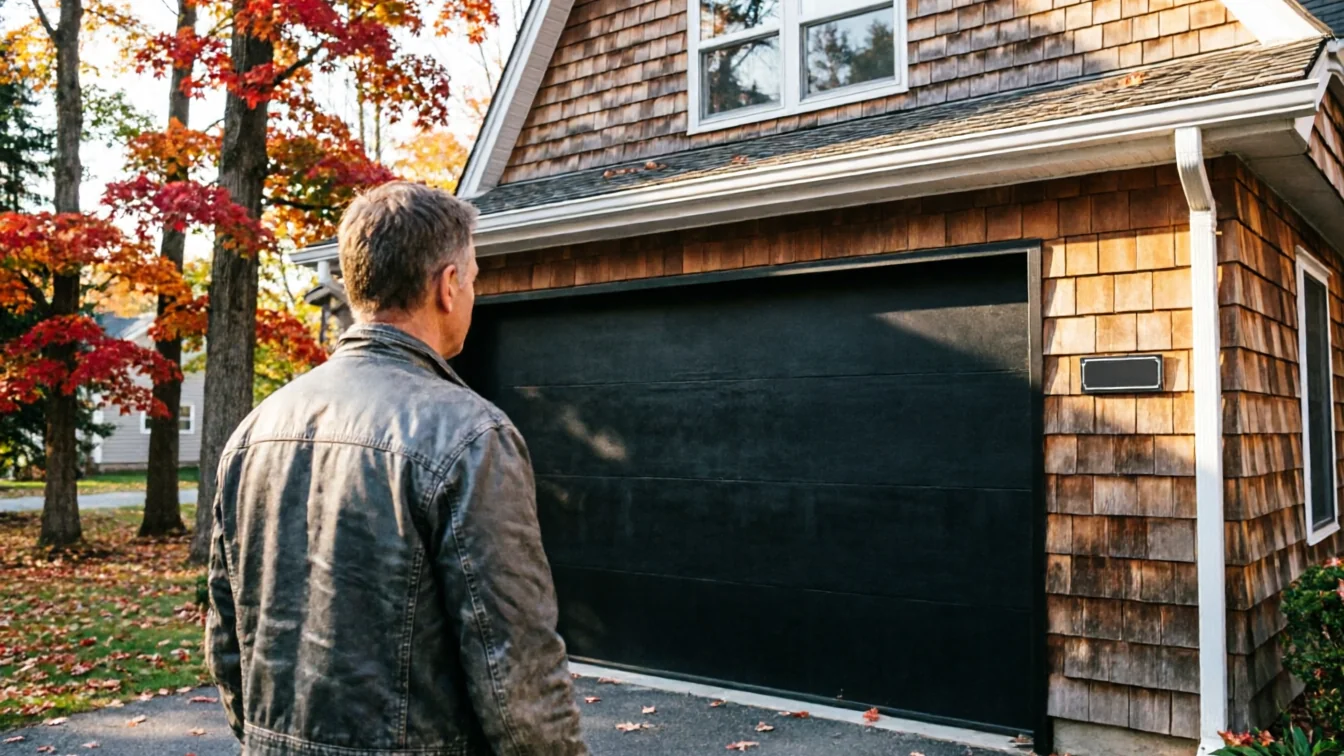
Replacing a Garage Door in Hanover: The Real Timeline
Most Hanover homes date back to the 1960s and 70s, built with doors never meant for today's cold stretches.
Read moreBlogHanover, PA · 5 min read
Most Hanover garage doors date to the 1938-1994 building boom, before insulation codes existed. Here's what that means for cold-weather doors and repair choices.
Local detail
Walk through most neighborhoods around Hanover and you're looking at houses built between 1938 and 1994, with the median sitting at 1972. That's the window that matters, because it's decades before anyone wrote an insulation requirement into a garage door standard. The bulk of what's out there is 1960s and 70s construction - a single layer of steel, maybe a thin foam liner added later if a past owner cared, and that's it.
This isn't a defect. It's just what builders put in at the time, and it held up fine for the climate assumptions of that era. The problem is the door is still doing the same job fifty-plus years later, on a house where everything else - windows, attic, water heater - has probably been touched at least once. The garage door is the one component nobody thinks about until it's loud, slow, or letting in more cold than it should.
If you own one of these original houses, there's a good chance the door predates any insulation expectation entirely. Knowing that changes what you should actually be asking a repair tech to look at, instead of assuming a new opener or a quick lube job solves a problem that's really about the door panel itself.
The area
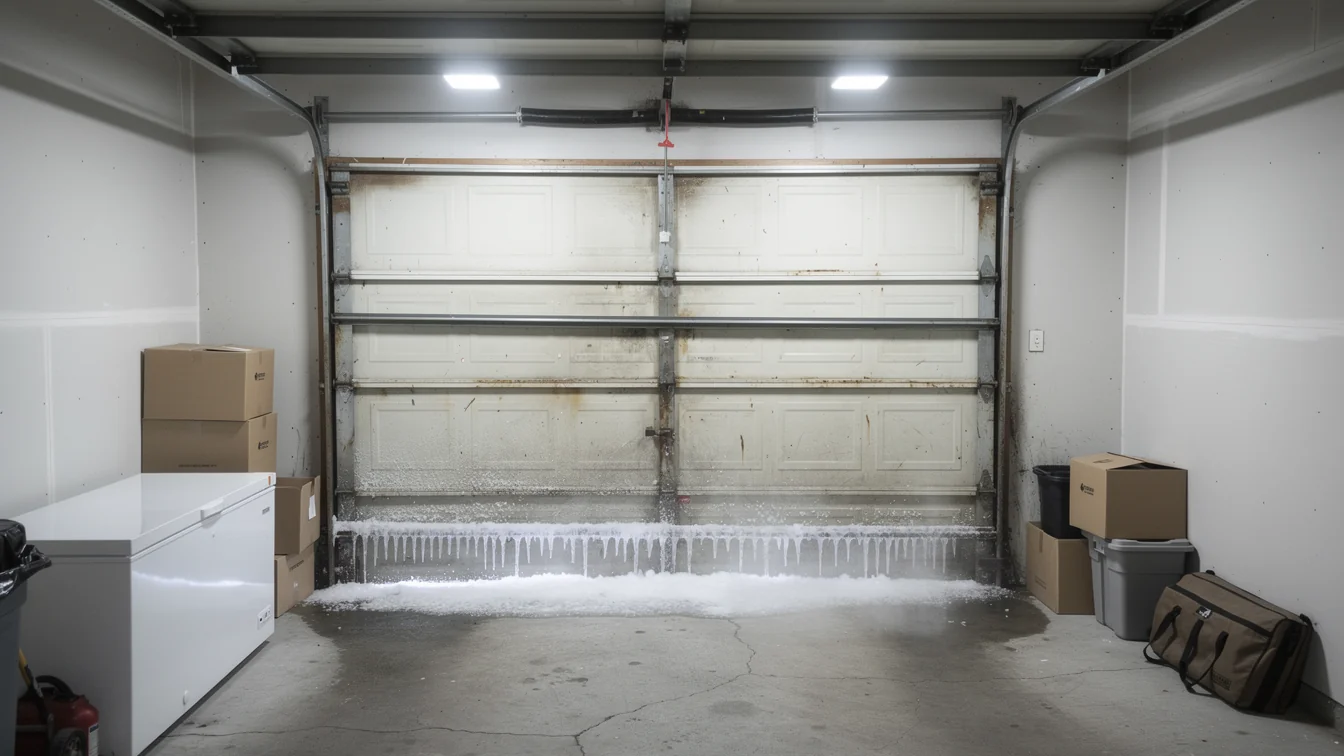
Hanover sits in a climate band classified as cold and severe. That matters more for an uninsulated door than people expect, because a garage isn't just storage space here - it's often attached to the house, sharing a wall with a living space or sitting under a bedroom. An uninsulated steel panel from the 1960s or 70s doesn't do much to slow that transfer. You feel it as a cold floor above the garage, or a laundry room that never quite warms up.
It also changes how hardware behaves. Steel contracts in cold, and on an original door the tolerances were never tight to begin with. Rollers that were fine in July start binding in January. Torsion springs lose a little tension capacity as temperatures drop, which is a normal physical property of the steel, not a sign anything's broken - but it's exactly why a spring that was marginal in fall finally lets go on the coldest week of the year.
None of this means the door is unsafe to use. It means cold-season symptoms on an old uninsulated door are often the door telling you its age, not a new problem showing up out of nowhere.
What we find
The most common mistake we see on these older houses is treating a cold-weather symptom as an opener problem. Someone notices the door is sluggish or noisy in January and the first move is to replace the opener motor. On a house from the 1960s or 70s stock, the motor is rarely the actual issue - it's the door itself working harder because the panel, the weatherstripping, and the hardware were never built to modern standards, and cold just exposes that.
The second mistake is adding insulation kit panels to a door that's otherwise failing mechanically - bent track, worn rollers, a spring near the end of its life. Foam board stuck to the inside of an old panel helps a little with temperature, but it adds weight, and added weight on original 1960s-era springs and tracks accelerates wear on hardware that was already sized for a lighter door.
The honest answer, most of the time, is that insulating an original door from this era is a smaller fix than people think, and replacing the whole door is a bigger one than people think. Which direction makes sense depends on the actual condition of the panel, not just its age.
How we work
Not every symptom on an older Hanover house needs immediate attention. If the door is just a little noisier than it used to be, or a touch slower closing on the coldest mornings, that's often the hardware adjusting to seasonal contraction, not failure. A once-a-year lube and a visual check of the cables and rollers is usually enough to get through winter without a service call.
We'll say plainly: we don't push insulation retrofits on doors that are structurally sound and closing properly. If the only complaint is that the garage feels cold, and the door itself opens, closes, and seals at the bottom without issue, that's a judgment call for the homeowner, not an emergency repair. Given a median household income of $79,094 in this area, we'd rather tell you a door has a few good years left than talk you into work it doesn't need yet.
Where waiting stops being fine is a spring under visible tension that's rusted or frayed, or a door that's started sagging on one side. Those don't improve with patience, and cold makes a failing spring let go faster, not slower.
Questions
If your house was built before the 1990s, which covers most of the Hanover area, there's a strong chance the original door is a single layer of steel with no foam core. Look at the edge of the door - a hollow-sounding knock and a thin profile usually mean uninsulated. A tech can confirm it in a few minutes on site.
In a cold-severe climate like Hanover's, yes, especially if the garage shares a wall or ceiling with living space. It won't show up as a huge heating bill line item, but it shows up as a cold floor above the garage and faster wear on hardware that contracts in low temperatures.
Depends on the door's actual mechanical condition, not just its age. A sound panel with worn weatherstripping is a cheap fix. A door with bent track, sagging panels, or a tired spring is better replaced outright - insulating a failing door just adds weight to hardware that's already struggling.
Yes. Torsion springs lose some tension capacity as steel gets cold, so a spring that was already near the end of its life often fails in the coldest stretch of winter rather than in summer. It's not sudden damage - it's an old part finally giving out under normal seasonal stress.
Recommendation
More garage door guides for Hanover homeowners.
Most Hanover homes date back to the 1960s and 70s, built with doors never meant for today's cold stretches.
Read more
Hanover homes built mostly between the 1960s and 1972 run older torsion springs that snap fast once cold weather hits.
Read more
Hanover homes built mostly in the 1960s and 70s carry original hardware that talks before it fails.
Read moreReady when you are
Hanover Garage Door Pros repairs and installs garage doors, springs and openers in Hanover, PA and the surrounding area.